


 Poison Ivy
Urushiol, the oil from the poison ivy plants that causes the allergic reaction, can stay active on any surface for up to five years. These surfaces could include gardening tools, clothing, and dead plants.
"Leaves of three, let them be" is a common rhyme that works with poison ivy, but not with poison oak and poison sumac (neither of which we have noticed in this neck of the woods.)
Poison ivy has compound leaves, which means that each leaf is comprised of three leaflets. The leaflets are most commonly toothed or lobed, but can also be smooth-edged. Poison ivy leaves are alternate, meaning that they alternate growing on the right side, then the left side, of the main vine. The middle leaflet has a longer stem than the two side ones. The leaves are bigger at the base of the plant.
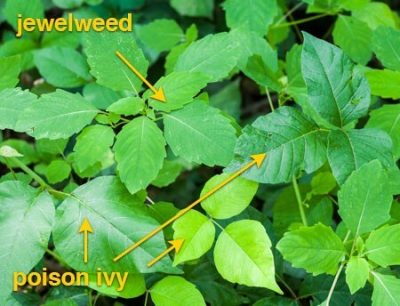 From spring to summer you can find their leaves shiny green. In the fall their leaves turn reddish orange. The oil, urushiol, contained in this plant is what gives the leaves a glossy, waxy appearance.
The flowers are five grayish, white, yellow or green petals growing in clusters. They are 1/8 inch to 1/2 inch in diameter. The poison ivy plant flowers from May to July. Berries form in summer, and are small, 1/4 inch round, hard white or cream-colored balls drooping from the leaf axils.
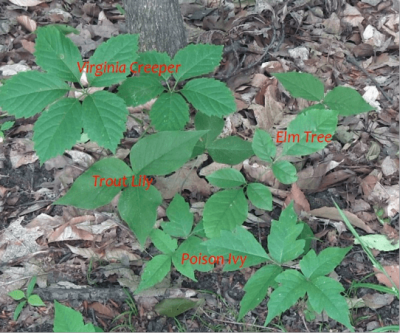 The poison ivy plant is a transformer and can take many appearances. It can be a hairy vine climbing up trees and other vertical objects up to 100 feet tall. It can grow as a ground cover up to 2 feet tall, and it can also grow as an erect busy shrub up to 4 feet tall. Don't depend on it's overall appearance alone for identification.
KIM'S TIP: None of the three leaves on a Poison Ivy leaflet are SYMETRICAL (look for jigs and jags and smooth lines, but notice if they are evenly matched on both sides or not. If not, you're likely looking at Poison Ivy. 🙂 )
POISON IVY RELIEF:
If you do contract a rash, it could show up in as early as four hours on your skin. It can also take as long as 48 hours to break out. You might get a simple red rash, your skin could streak, your eyes could swell shut or your skin could bubble and blister.
Contrary to popular belief, poison ivy isn't contagious, nor does it spread to other parts of your body (though it may seem like it does because the rash takes time to fully materialize.)
The only way it can be transmitted is through contact with the oil itself, so if you find yourself afflicted with the rash it's important to track down every last trace of urushiol.
Wash your skin thoroughly the instant you realize you've come into contact with the itchy plant. If urushiol is washed off before it is fully absorbed into the skin, you can minimize the damage. You've got about 10 minutes, so get moving.
Don't attempt to destroy the offending plants or any contaminated items with fire. Urushiol can become airborn when burned, and you do not want to be inhaling that stuff.
Natural home remedies to remedy the poison ivy rash:
- Baking soda: Make a thick paste and apply to the rash area, it will dry out the blisters and relieve the itch.
- Witch Hazel: a natural alternative to rubbing alcohol, witch hazel is an astringent that's great for cleansing and drying the blisters.
- Oatmeal: grind up oatmeal and add to a warm bath; the oatmeal will help relieve the itching immediately (you can also make an oatmeal poultice to cover the affected area--leave on for 15 minutes then was off gently.
Over-the-counter pharmacy aids: Calamine Lotion, Cortisol Creams, etc.
If you're especially fed up with poison ivy, you can try moving to Alaska or Hawaii, both of which are toxicodendron-free (lacking poison ivy/oak/sumac), however you may just be trading in contact dermatitis for bigger problems like bears and volcanoes.


